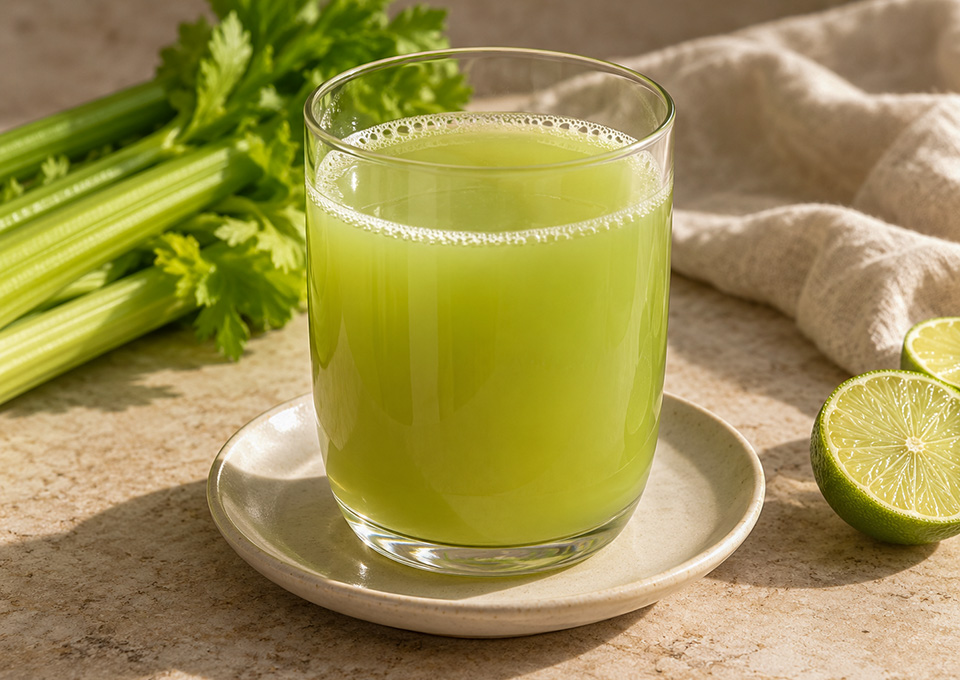
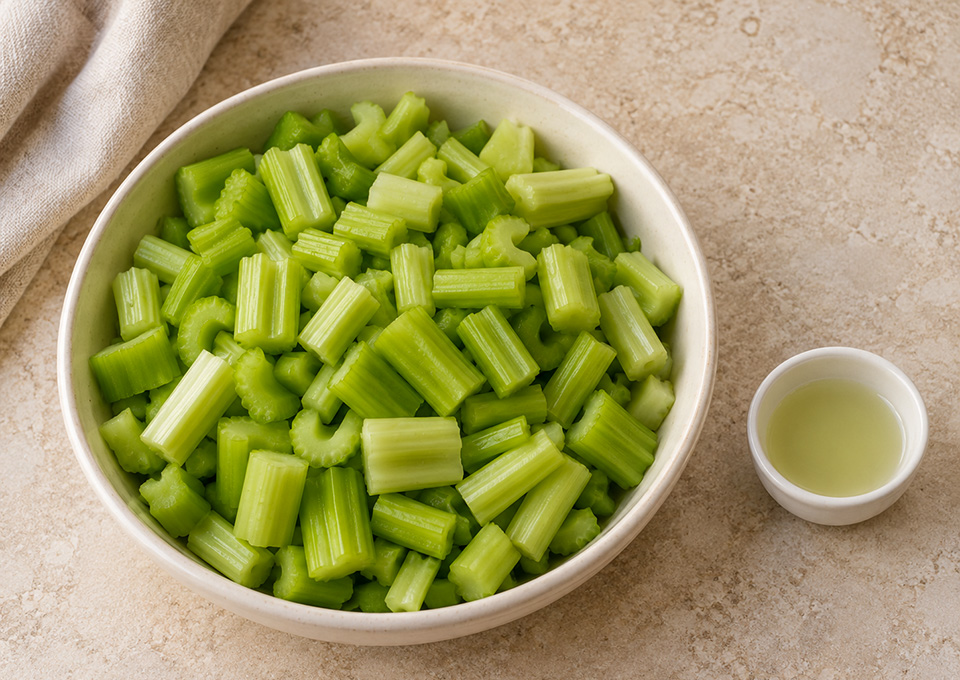
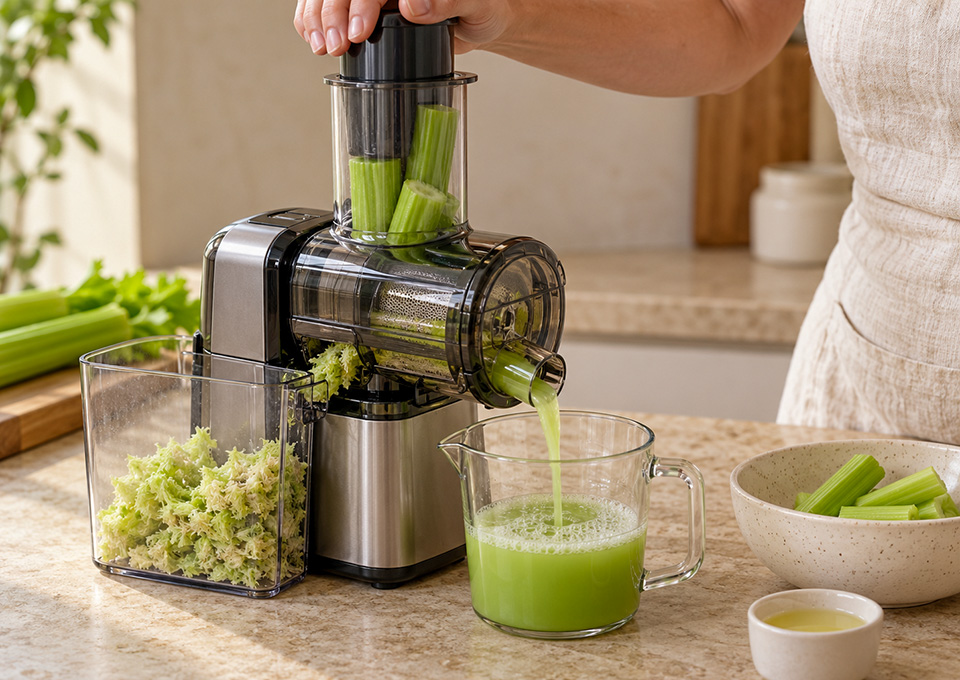
The crisp celery stalks we juice today trace back to varieties grown in Italy in the 1500s. As celery spread to France and England, growers selected for thicker, crisper stalks and a milder flavor. In 1943, the New York State Agricultural Experiment Station in Geneva, New York, included celery juice in a guide to making fruit and vegetable juices at home. For our version, we run fresh celery through a juicer and stir in a tablespoon of freshly squeezed lime juice. The lime gives the savory celery a bright, tart finish. One batch makes a generous glass to serve chilled.
Fresh lime brightens celery’s crisp, savory flavor. Just two ingredients, with no added water or sweeteners. A smooth, freshly extracted drink ready in 10 minutes.
Makes: 1 large glass, approximately 1½ cups (350 ml). Actual yield varies with the celery and juicer.
Estimated nutrition per 100 ml: 19 kcal, 3.7 g carbohydrates, 0.4 g protein, and 0 g fat.
Estimated nutrition per glass (350 ml): 65 kcal, 13 g carbohydrates, 1.5 g protein, and 0 g fat. Values are approximate; fat is rounded.
A BITE OF HOPE · RECIPE TOOLS
Values per 100 g provide a common basis for comparing protein, carbs, and fats across foods—for example, 100 g of chicken breast versus 100 g of this recipe. This is not a recommended serving size. You do not need to weigh your meal or serve yourself exactly 100 g.
Calculated from ingredient weights. Cooking may change the final values per 100 g.
No ingredients found in the existing recipe Ingredients field.
Serving quantities are scaled only when a recognizable amount and unit can be safely parsed. Existing nutrition values are displayed as entered; estimates per 100 g use known or supported estimated ingredient weights.
Tips